



How Handicap Betting Balances Uneven Matches
Handicap Betting changes the score used for settlement before the match is judged as a bet. A favorite starts with a virtual disadvantage, while an underdog receives a head start. The aim is simple: Explain how handicap lines reshape an uneven match and determine whether a selection wins, loses, pushes, or settles partially in Sports betting.
Handicap Betting Starts With the Score Adjustment
A football match can look one-sided before kick-off. One team may have better form, a deeper squad, and a clear home advantage. A straight win market reflects that gap, often leaving the favorite at short odds. Handicap Betting approaches the same matchup differently.
Instead of asking only who wins, the handicap asks whether a team can perform beyond a specified margin.
A favorite normally receives a negative line:
- -0.5 means the team must win.
- -1 means a one-goal victory may result in a push under Asian Handicap rules.
- -1.5 means the team must win by at least two goals.
The underdog receives the opposite treatment. A positive handicap gives it room to lose by a limited margin and still produce a winning handicap result.
The Favorite Carries the Negative Line
Suppose Team A is heavily favored and carries a -1.5 handicap. A 1-0 victory looks perfectly good on the league table, but not for that handicap selection. After subtracting 1.5 goals, the adjusted result no longer favors Team A.
That is the first habit worth building: Do not judge a handicap ticket from the actual winner alone.
A -1.5 favorite needs separation on the scoreboard. Winning is only half the job.
The Underdog Gets Margin Protection
The same fixture looks very different from the other side. If Team B has +1.5, it can lose 1-0 and still cover the handicap.
This is where newcomers sometimes feel the result is contradictory. Team B lost the match, yet the +1.5 selection won. There is no contradiction because two different results are being measured: The official match result and the adjusted handicap result.
Actual Score and Handicap Score
Consider this result:
- Actual score: Team A 2-1 Team B
- Handicap: Team A -1
- Adjusted score: 1-1
Under a standard Asian Handicap -1 line, that exact one-goal winning margin produces a push. The stake is returned.
The match score tells you who won. The handicap score tells you how the bet settles.
Handicap Lines and Their Settlement
Not every handicap behaves the same way. The decimal attached to the line matters because it controls whether a push, full win, partial win, or loss is possible.

Handicap Lines and Their Settlement
Whole-Number Handicaps
Whole lines such as 0, -1, +1, -2, and +2 can create a push in Asian Handicap Betting.
Imagine backing a favorite at -1:
- It wins 3-1: The selection wins because the victory margin is two goals.
- It wins 2-1: The handicap produces an adjusted draw, so the bet pushes.
- It draws or loses: The selection loses.
A push is not a winning bet at reduced profit. It normally means the original stake is returned.
The zero handicap deserves attention as well. Often called Draw No Bet in similar market structures, a 0 line removes the draw as a losing outcome: A win pays, a loss loses, and a draw returns the stake.
Half-Goal and Half-Point Lines
Lines such as -0.5, +0.5, -1.5, and +2.5 remove the possibility of an exact handicap tie.
No football team can win by 1.5 goals. That mathematical detail is intentional.
For a -1.5 favorite:
- Win by two or more: Handicap win.
- Win by exactly one: Handicap loss.
- Draw or lose: Handicap loss.
For the +1.5 underdog, the logic reverses. It remains successful unless it loses by at least two goals.
Half lines therefore create clean two-way settlement: Win or lose.
Quarter-Handicap Lines
Quarter lines such as -0.25, +0.25, -0.75, and +0.75 add another layer. Instead of settling the full stake against one number, the wager is effectively divided across two neighboring handicap lines.
For example, -0.75 combines:
- Half the stake on -0.5
- Half the stake on -1
Half-Win and Half-Loss Results
Suppose ₱1,000 is placed on Team A -0.75.
If Team A wins by two goals, both halves win.
If Team A wins by exactly one, the -0.5 portion wins while the -1 portion pushes. That produces a half-win.
If Team A draws, both portions lose.
Quarter handicaps look complicated on a betting screen, but the split-line method makes them much easier to calculate.
Asian Handicap and European Handicap
The word “handicap” does not always describe the same settlement system. Asian Handicap and European Handicap may display similar numbers while producing different outcomes.
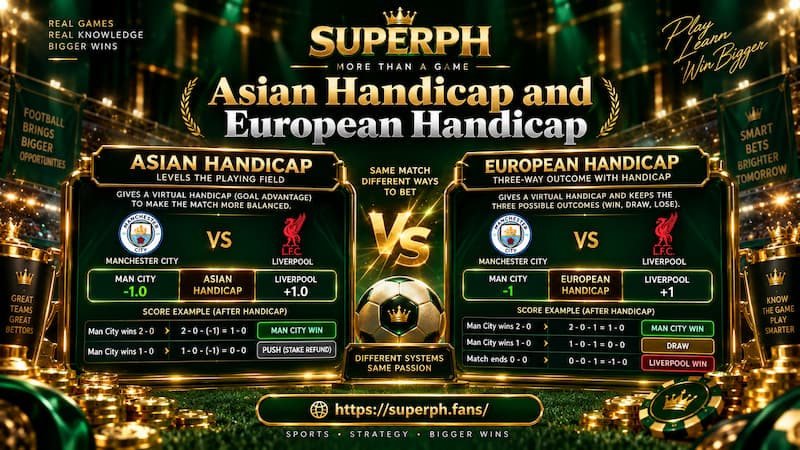
Asian Handicap and European Handicap
Asian Handicap Uses Two Main Sides
Asian Handicap is built around the competing teams rather than a three-way home-draw-away result. Depending on the line, a stake may be returned or split between two outcomes.
This is why whole and quarter lines deserve careful attention. A one-goal victory with -1 does not behave like a one-goal victory with -1.5.
European Handicap Keeps the Draw
European Handicap is usually a three-way market. The virtual handicap is applied, then the adjusted result can finish as:
- Home win
- Handicap draw
- Away win
That draw option changes settlement completely.
One Winning Margin, Two Different Settlements
Take a favorite carrying -1 that wins 2-1.
Under Asian Handicap -1, the adjusted score becomes 1-1 and the selection typically pushes.
Under European Handicap -1, that same adjusted 1-1 score makes the handicap draw the winning selection.
Reading the market name is therefore just as important as reading the number beside the team.
Balancing a Strong Favorite and a Weaker Opponent
Handicap Betting does not make two teams equally strong. It changes the condition each selection must satisfy.
If one club is expected to dominate, giving it -1.5 or -2 forces bettors to consider the likely winning margin rather than simply predicting a victory. A weak opponent receiving +1.5 gains protection against a narrow defeat.
That creates a more demanding question.
Instead of:
“Will the favorite win?”
The handicap becomes:
“Will the favorite win comfortably enough to cover this line?”
Strong Favorites Need Separation
Consider a top club facing a relegation candidate. The favorite might control possession, create more chances, and win 1-0. That performance earns three league points, but someone holding -1.5 still loses the bet.
Margin matters.
In this situation, team quality alone is not enough. Finishing ability, match tempo, substitutions, motivation, defensive resistance, and even whether the favorite tends to protect narrow leads can become relevant to the handicap.
Underdogs Can Lose and Still Cover
Backing +1.5 does not mean predicting an upset. It means accepting the possibility of defeat while expecting the game to remain reasonably close.
That distinction makes positive handicaps useful when a weaker side appears capable of resisting pressure even if an outright win looks unlikely.
Handicap Size Expresses the Expected Gap
Larger perceived mismatches generally require larger handicap adjustments. A closely matched fixture may sit near 0 or ±0.25. A stronger favorite could move to -1, -1.5, or beyond.
The number is not a guaranteed forecast of the final margin. It is a betting line that defines the settlement condition.
A Handicap Betting Example in PHP
A single example is often more useful than several abstract definitions.
Assume Team A is listed at -1.5 and Team B at +1.5.
A bettor places ₱1,000 on Team A -1.5.
Favorite -1.5
Possible results:
- Team A wins 3-1: The bet wins.
- Team A wins 2-0: The bet wins.
- Team A wins 2-1: The bet loses.
- Team A draws 1-1: The bet loses.
A one-goal victory is insufficient because the handicap requires Team A to finish at least two goals ahead.
Underdog +1.5
Now take the other side with ₱1,000 on Team B +1.5.
- Team B wins: The bet wins.
- The match ends in a draw: The bet wins.
- Team B loses 2-1: The bet still wins.
- Team B loses 3-1: The bet loses.
Settlement Depends on the Margin
This is the practical heart of Handicap Betting. You are not simply choosing which team is better. You are choosing whether the final margin lands above or below a specific line.
Reading Handicap Markets on SUPERPH
When checking a sports market on SUPERPH, read the handicap before focusing on the odds. A slightly better price means little if the line itself has been misunderstood.
A useful reading order is:
- Identify the team.
- Check whether the handicap is positive or negative.
- Read the exact value: -0.5, -1, -1.25, +0.75, and so on.
- Confirm whether the market is Asian Handicap or another handicap format.
- Check the betting period.
- Only then compare the odds.
Check the Betting Period
Full-match and first-half handicaps are separate markets. Live handicap lines can also be offered while the match is already underway.
A -0.5 first-half selection is judged on that stated period, not automatically on the final 90-minute score. The market label defines the scoring window used for settlement.
Handicap Betting Errors That Change the Outcome
Most costly misunderstandings come from reading the team first and the handicap second.
Treating a Match Win as a Handicap Win
A favorite can win 1-0 and still fail to cover -1.5. Always calculate the required margin.
Mixing Asian and European Handicap Rules
An adjusted draw can mean a push in one market and a winning draw selection in another. Similar-looking lines should never be assumed to settle identically.
Reading Quarter Lines as Single Lines
A -0.75 bet is not simply a strange version of -0.5. It represents two split positions, which is why half-win and half-loss settlements exist.
Ignoring the Market Period
First-half, full-match, and in-play handicap markets can produce different results from the same fixture. Check the stated period before confirming the selection.
Handicap Betting Comes Down to the Required Margin
Handicap Betting turns an uneven matchup into a question of distance between the teams on the scoreboard. The favorite must overcome an imposed disadvantage, while the underdog receives a scoring cushion.
Once the sign, line size, market type, and settlement period are clear, the market becomes far easier to read. The strongest team does not automatically produce the strongest handicap selection. The decisive detail is whether the final margin covers the line you accepted.