


How RNG Keeps Online Casino Games Random
RNG determines how digital casino games produce outcomes from random or pseudorandom values. The goal here is to show how those values are generated, mapped to reels, cards and numbers, and tested for distribution, independence and unpredictability in online casino software.
RNG and Casino Game Outcomes
A reel in a slot game can spin for three seconds, a roulette ball can circle a virtual wheel and a card can flip with a polished animation. None of those visual effects necessarily creates the result. In an RNG-based game, the important work happens underneath.
The Random Number Generator produces numerical values that the game’s mathematical logic converts into eligible outcomes. Depending on the game, that can mean a reel position, card, roulette number, bingo value or bonus event.
A simplified sequence looks like this:
- The game requests a value from the RNG.
- That value is processed through the game’s mathematical rules.
- The software maps it to an eligible outcome.
- The screen displays the corresponding reels, cards, numbers or animation.
That distinction is important. RNG does not simply decide that someone “wins” or “loses.” It supplies the values used by game mathematics to produce the final result.
Scaling, Mapping and Shuffling
Raw RNG output can cover an enormous numerical range, while a game may need only 52 card positions or a defined set of virtual reel stops. Software therefore has to convert the generated value into something the game can use.
The conversion cannot quietly favor certain results. GLI-19 requires scaling, mapping and shuffling methods used in interactive gaming systems to be reviewed for bias.
A digital card shuffle is a good example. Generating random numbers is only half the job; the method used to translate those numbers into the card order also has to preserve the intended probabilities.
Software, Hardware and Mechanical RNG
Online casino games commonly rely on software-based random or pseudorandom number generation. “Pseudorandom” sometimes sounds suspicious because the numbers are produced algorithmically rather than appearing from nowhere. Technically, however, predictable-looking code and predictable results are very different things.

Software, Hardware and Mechanical RNG
A properly designed PRNG can produce outputs that are computationally impractical to forecast, particularly when its internal state and seeding are handled securely.
PAGCOR’s technical standards recognize several approaches, including mechanical RNGs, hardware RNGs, cryptographic RNGs and PRNGs. The method itself is not enough to establish quality; its implementation must meet the required randomness criteria.
Unpredictability Is the Core Requirement
Knowing yesterday’s lottery numbers does not reveal tomorrow’s draw. The same principle applies to properly implemented casino RNG.
Previous outputs should not provide a usable shortcut to future ones. A sequence such as loss-loss-loss-win may happen, but the pattern alone does not establish that the fourth result was “scheduled” after three losses.
Random Does Not Mean Equal Chances
One of the most common misunderstandings around RNG comes from treating “random” as another word for “equal.”
It is not.
A random result can still come from a game where different outcomes have very different probabilities.
Imagine a slot with an ordinary symbol that appears frequently and a jackpot symbol designed to appear extremely rarely. RNG can still select outcomes correctly even though those two symbols have nowhere near the same probability.
The important point is that each RNG value is processed according to the approved mathematical model rather than altered because of previous wins, losses or visual patterns.
Weighted Symbols and Paytables
Digital slots often use virtual reel structures rather than giving every displayed symbol, including a wild symbol, identical mathematical weight. A cherry might correspond to many possible reel positions while a high-value symbol corresponds to far fewer.
That does not make the selection non-random. It means the RNG is sampling from a deliberately weighted game model.
PAGCOR’s EGM technical standards require symbol probability to remain constant unless the paytable specifies otherwise. They also require simulated casino games such as roulette, poker and blackjack to preserve the corresponding probabilities where applicable.
RNG, RTP and Volatility
These terms are closely related to game mathematics but they describe different things.
RNG handles outcome selection. RTP represents the theoretical percentage of wagered value returned over a very large sample under the game’s mathematical model. Volatility describes how those returns tend to arrive: Frequent smaller results, less frequent larger results or something between the two.
A 96% RTP game does not promise that PHP 1,000 played tonight will return PHP 960. A short session can finish far above or below that figure because RTP is a long-run mathematical expectation.
Changing a wager from PHP 10 to PHP 100 also does not inherently make the RNG more favorable. Different bet levels can, however, activate different paylines, jackpots or bonus conditions when the game rules explicitly say so.
How RNG Testing Works
Calling software “random” is easy. Testing it properly is much harder.
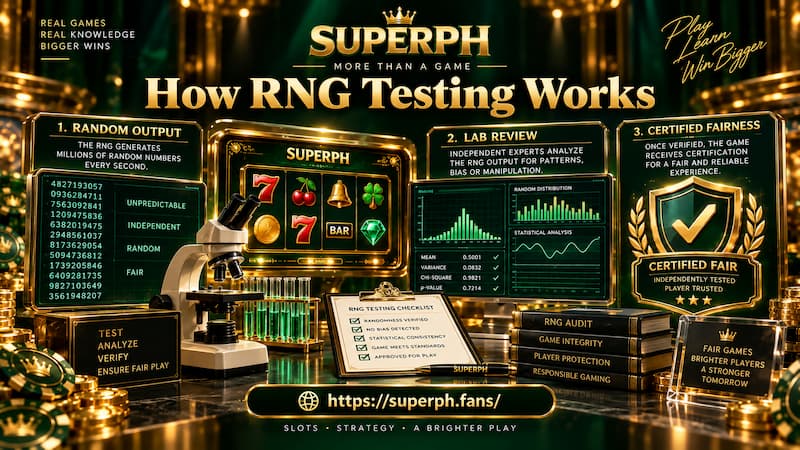
Independent laboratories examine both the RNG itself and the way its output interacts with the game. Testing can include source-code review, mathematical analysis and large samples of generated values rather than a tester simply playing a few hundred rounds and deciding the results look normal.
How RNG Testing Works
Source Code Review
Technical reviewers can examine the random-number algorithm, seed handling, shuffling logic, scaling and mapping procedures, as well as implementation details capable of introducing bias.
A flawless mathematical concept can still fail if it is coded badly. For example, a careless method of shrinking millions of possible RNG values into 37 roulette outcomes could make some numbers fractionally more likely than others.
Statistical Distribution and Independence
Large data sets are tested for characteristics such as distribution, runs and correlation. GLI-19 requires appropriate statistical testing and addresses both independence and intended distribution in RNG output.
Distribution asks whether outcomes appear with frequencies consistent with the intended mathematical model.
Independence asks a different question: Does knowing earlier selections provide useful information about the next selection?
Those two tests catch different problems. A sequence could appear evenly distributed overall yet still contain a hidden relationship between consecutive values.
Cryptographic Strength and Seeding
For interactive gaming, predictability is particularly sensitive because software can be exposed to remote users continuously. Secure RNG design therefore has to consider internal state, seed generation and resistance to reconstruction.
A weak seed is dangerous. If someone could infer it from something simple such as system time, even a sophisticated-looking algorithm might eventually become predictable.
RNG Standards in the Philippines
RNG is not treated as a vague marketing feature under Philippine electronic-gaming requirements.
PAGCOR’s regulatory framework requires applicable gaming systems and game content using RNG to obtain certification from a reputable independent gaming laboratory. Its current framework recognizes established technical standards including GLI-19 Version 3.0 for interactive gaming systems.
That creates an important distinction between a casino brand and the software underneath individual games.
When using RNG-based games through SUPER PH, the useful technical question is not whether the reel animation feels unpredictable. The stronger evidence comes from the game software, provider, mathematical model and applicable laboratory certification behind the RNG.
Independent Testing Has a Defined Scope
“Certified RNG” should never be interpreted as a magic stamp covering everything connected to a casino.
Certification can apply to a specific RNG implementation, gaming system, software version or collection of games. A change to game mathematics or software may require separate evaluation depending on the regulatory framework.
Specific certification details are therefore more meaningful than a decorative badge with no laboratory, standard or software information attached.
RNG Across Different Casino Games
RNG does not appear in exactly the same form everywhere.
Slots and Reel Games
For digital slots, generated values are mapped to reel positions or equivalent mathematical outcomes. The spinning animation then represents the selected result.
This is why watching a reel slow down cannot reveal that a jackpot was “almost due.” The animation is presentation; the mathematical selection is the substance.
Digital Cards and Roulette
In fully simulated blackjack, baccarat, poker-style games or roulette, software can use RNG values to reproduce the intended card or wheel probabilities.
A digital roulette game with 38 positions, for instance, should preserve the mathematical relationship associated with those 38 possible results when it represents an American-style wheel.
Live Dealer Games
Live dealer tables need a separate distinction. If real cards are dealt or a physical roulette wheel is spun and streamed in real time, the primary result can come from physical equipment instead of the same software RNG process used by a digital slot.
That is why “online casino game” and “RNG game” should not automatically be treated as identical categories.
Common RNG Misconceptions
A Win Is Not Due After a Losing Streak
Five losing spins do not make the sixth spin inherently more likely to win in a properly independent RNG game.
Humans are exceptionally good at seeing patterns. After several reds on roulette, black can suddenly feel overdue. Mathematically, previous independent outcomes do not create a debt that the next result must repay.
Random Does Not Mean 50/50
A game can randomly sample an outcome with a 1% probability alongside another outcome with a 20% probability.
Randomness describes how the defined probability model is sampled. It does not require every possible result to have identical odds.
Near-Misses Do Not Predict Future Results
Seeing two jackpot symbols followed by a third reel stopping one position away can be frustratingly memorable. It still does not tell you that the next spin is closer to a jackpot.
PAGCOR’s technical standards specifically address outcome presentation and prohibit secondary decisions that manipulate a selected losing outcome to manufacture a near-miss scenario.
Checking an RNG Claim
A serious RNG claim should lead to evidence rather than stop at the word “certified.”
Look for details such as the testing laboratory, technical standard, software or game version covered, certificate information and the scope of the evaluation. Those details make it possible to distinguish a meaningful technical certification from a generic trust badge.
Game Rules Still Matter
Even excellent RNG testing does not tell you whether a particular game fits the way you want to play.
The paytable, RTP, volatility, jackpot mechanics and bonus conditions still define the economic structure around those random outcomes. RNG ensures that the selection process follows the intended model; it does not make every wager equally valuable or every game equally generous.
RNG as Part of Fair Game Design
RNG sits at the center of digital casino game integrity because it separates genuine mathematical selection from predictable scripting. But randomness is only one layer. Reliable game design also requires correct probability mapping, secure implementation, independent testing and rules that accurately describe how outcomes are paid.
Once those pieces are separated clearly, RNG becomes much easier to understand: It generates uncertainty inside a defined mathematical system rather than creating mysterious luck behind the screen.