



How the Ante Bet Works in Three Card Poker
Ante Bet in Three Card Poker is the opening wager that puts your three-card hand directly against the dealer. The goal here is simple: explain when the Ante is placed, when a matching Play bet is required, how dealer qualification changes the result, and where the payouts come from.
Ante Bet in Three Card Poker
The Ante is the starting point of the dealer-versus-player side of Three Card Poker. You place it before any cards are dealt, then receive three cards and decide whether the hand is strong enough to continue.
That second decision is important. The Ante does not automatically carry the hand to settlement. After seeing your cards, you either fold or place a Play bet equal to the original Ante.
For example, suppose you sit down with PHP 5,000 in your balance and choose a ₱500 Ante. Once the cards arrive, a decision to continue requires another ₱500 as the Play bet. Your total exposure on that hand becomes ₱1,000 before any optional side bets are counted.
This makes the Ante different from Pair Plus. Pair Plus judges the strength of your own three cards against a separate paytable. The Ante starts a direct contest against the dealer and creates a second decision after the cards are visible.
Ante and Play Bet Sequence
A standard hand follows a short sequence:
- Place the Ante before the deal.
- Receive three cards and inspect the hand.
- Fold if you do not want to continue, losing the Ante.
- Place a Play bet equal to the Ante if you continue.
- The dealer reveals three cards.
- Dealer qualification is checked before the final comparison.
At SUPERPH, if Three Card Poker is opened through a live casino tab, the practical point is to treat the Ante and Play as connected wagers rather than assuming the amount shown in the Ante box represents the maximum cost of the hand.
A ₱500 Ante in Practice
Take a simple ₱500 example. You place ₱500 on Ante and receive Q♠ 9♦ 7♣. If you continue, another ₱500 goes on Play.
Your commitment is now ₱1,000.
If you fold instead, there is no Play wager, but the original ₱500 Ante is lost immediately. That trade-off is the heart of basic Ante strategy: Continuing costs another unit, while folding guarantees the loss of the unit already placed.
Dealer Qualification Changes the Settlement
The dealer does not automatically compare every hand against yours. Under standard Three Card Poker rules, the dealer must have Queen-high or better to qualify.

Dealer Qualification Changes the Settlement
That means Q-2-3 qualifies. So does any pair, flush, straight, three of a kind, or straight flush.
This rule creates two very different settlement paths.
Dealer Does Not Qualify
If the dealer finishes below Queen-high, the regular head-to-head comparison stops there.
The standard result is:
- Ante pays 1:1.
- Play pushes and is returned.
- Your hand does not need to beat the dealer’s hand in the normal qualifying comparison.
Suppose you continue with K-7-3 and the dealer turns over J-9-8. The dealer has failed to qualify. Your Ante wins even money, while the Play stake comes back unchanged.
Dealer Qualifies With Queen-High or Better
Once the dealer qualifies, the actual hand comparison decides both wagers.
If your hand ranks higher, the Ante and Play normally pay 1:1. If the dealer has the better hand, both wagers lose. When the hands tie exactly, both bets push.
Imagine you have A♣ J♠ 5♦ while the dealer qualifies with Q♣ 10♥ 8♠. Your Ace-high beats the dealer’s Queen-high, so both Ante and Play win.
The situation changes sharply if the dealer shows a pair of 4s. A pair beats any high-card hand, so both of your wagers lose even though your highest individual card is an Ace.
Three Card Poker Hand Rankings
Three Card Poker uses familiar poker hands, but there is one ranking difference that catches experienced five-card poker players surprisingly often.
From strongest to weakest, the standard order is:
- Straight Flush
- Three of a Kind
- Straight
- Flush
- Pair
- High Card
The key detail is the position of the straight. In Three Card Poker, a straight beats a flush.
That feels backwards to anyone used to Texas Hold’em or traditional five-card poker. The reason comes from three-card probabilities: Making a straight with three cards is less common than making a three-card flush.
Reading High-Card Hands
When neither hand contains a pair or better, compare the highest card first. If those cards match, move to the second-highest card and then the third.
A-Q-4 therefore beats A-J-10 because the Aces tie and the Queen beats the Jack.
Small details like this matter around the dealer’s qualification line. Q-9-2 and Q-8-7 are both qualifying Queen-high hands, but Q-9-2 wins if they are compared directly.
Ante Bonus Payouts
The Ante Bonus adds another layer to the base wager. It rewards sufficiently strong three-card hands and should not be confused with Pair Plus.
In a common paytable, the Ante Bonus pays:
- Straight Flush: 5:1
- Three of a Kind: 4:1
- Straight: 1:1
The important distinction is that this bonus is based on the player’s hand strength. In standard versions, a qualifying Ante Bonus can still be paid even if the dealer eventually has the stronger hand.
Suppose you hold 5♠ 6♦ 7♣ for a straight. The dealer reveals 8♠ 9♣ 10♥, also a straight and a higher one. Your normal Ante and Play lose because the dealer wins the comparison, but the straight can still trigger the applicable Ante Bonus.
Paytable Differences
Do not memorize 5:1, 4:1 and 1:1 and assume it applies everywhere. Three Card Poker exists with multiple approved Ante Bonus schedules.
A SUPERPH table supplied by one game provider may therefore use a different bonus schedule from another version of Three Card Poker. Check the displayed rules and paytable before setting the stake, especially if the bonus payout is part of your expected return.
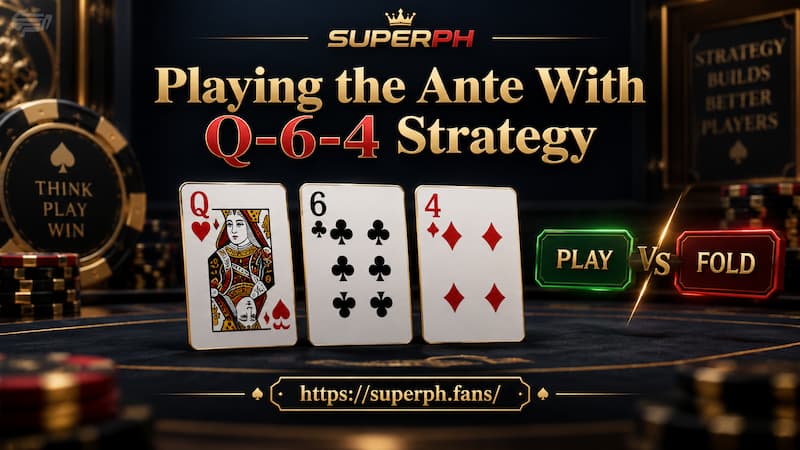
Playing the Ante With Q-6-4 Strategy
The best-known basic strategy for the standard Ante/Play game is compact enough to remember without a chart:
Playing the Ante With Q-6-4 Strategy
Continue with Q-6-4 or better. Fold hands below Q-6-4.
The wording matters. It does not mean “play every Queen.”
Consider three hands:
- Q-8-2 is a clear Play because the second card is higher than 6.
- Q-6-5 also continues because the Queen and 6 match the threshold, while the 5 kicker beats the required 4.
- Q-6-3 falls below the cutoff and should be folded under standard Q-6-4 strategy.
If the hand is a pair, straight, flush, three of a kind, or straight flush, it is already well above the threshold.
The Cost of a Marginal Decision
The logic becomes clearer when thinking in units rather than Peso amounts.
You already have one Ante unit at risk when the cards arrive. Folding guarantees the loss of that unit. Continuing puts one additional unit into Play but gives the hand a chance to recover the original Ante and produce a profit.
That is why the correct decision line can include hands that do not look particularly impressive. Q-6-4 is hardly a beautiful poker hand, yet mathematically it sits around the point where continuing becomes preferable to surrendering the Ante.
Under a commonly analyzed full-pay configuration using optimal strategy, the house edge on the initial Ante is approximately 3.37%, while the element of risk is around 2.01% when the additional Play wagers are included. Different paytables can alter the mathematics.
Ante Bet and Pair Plus Serve Different Purposes
Ante and Pair Plus may appear beside each other on the same Three Card Poker layout, but they answer different questions.
The Ante asks: Can your hand successfully continue against a qualifying dealer?
Pair Plus asks: Does your own three-card hand reach a paying combination?
Dealer qualification therefore matters to Ante/Play but does not decide a normal Pair Plus result. You could lose the dealer comparison and still collect Pair Plus if your cards meet its paytable requirements.
Keeping the two bets mentally separate also makes bankroll tracking cleaner. A ₱500 Ante, ₱500 Play and ₱200 Pair Plus represent three distinct wager components, not one ₱1,200 bet governed by a single result.
Common Ante Bet Errors
The most expensive mistakes usually come from misunderstanding settlement rather than from complicated strategy.
Treating a ₱500 Ante as the full potential commitment is one example. Continuing means another ₱500 Play wager must be added.
Another frequent mistake is comparing hands when the dealer has not qualified. If the dealer is below Queen-high, standard Ante/Play settlement applies before an ordinary head-to-head result is considered.
Five-card poker habits can cause trouble too. A straight beats a flush here, not the other way around.
Then there is the temptation to use “play any Queen” as an easy strategy shortcut. It is simple, but it is not the standard optimal cutoff. The 6 and 4 in Q-6-4 exist for a reason, particularly when the decision sits near the weakest playable Queen-high hands.
Checking the Three Card Poker Table at SUPERPH
Before placing an Ante in PHP, confirm the rules attached to the specific Three Card Poker game you have opened. Provider variations can affect the paytable even when the underlying Ante/Play structure looks familiar.
Check the Ante minimum and maximum, the required Play amount, dealer qualification threshold, Ante Bonus schedule and any optional side bets. These details take only a few seconds to verify, yet they determine exactly how much is at risk and how a winning hand is settled.
Once those pieces are clear, the Ante Bet in Three Card Poker becomes straightforward: One wager opens the hand, the cards determine whether another unit is worth committing, and dealer qualification determines how the final result is paid.