



What Happens When a Tongits Game Ends in a Tie?
Tie breaker in Tongits determines who wins when two or more hands finish with the same point total. This article explains the main tie situations, how challenger priority and the final stock card can affect the result, and why the active rules should be checked first.
Equal Points Do Not Automatically Mean a Replay
Two players reveal their cards. Both show 8 points. For a second, the table looks completely even.
Tongits normally does not stop there.
The ending condition decides which tie breaker in Tongits applies. A tie after someone calls Draw is handled differently from a tie caused by the stock pile running out. Traditional rules have an additional layer for both situations, so simply saying “lowest points wins” leaves out an important part of the game.
The two situations to separate are:
- Draw called and challenged: Equal totals can favor the challenger.
- Stock exhausted: The player connected to the final stock card or the following turn position can gain priority.
Traditional Tongits rules documented by Pagat distinguish these cases rather than treating every tied score in the same way. If the active version applies a different settlement, check FAQs first or contact superph support when the result still needs clarification.
A tied point count is only the first result. The way the round ended determines the final winner.
That distinction becomes especially useful late in a close hand, when a single Ace or low card can leave two competitors sitting on identical totals.
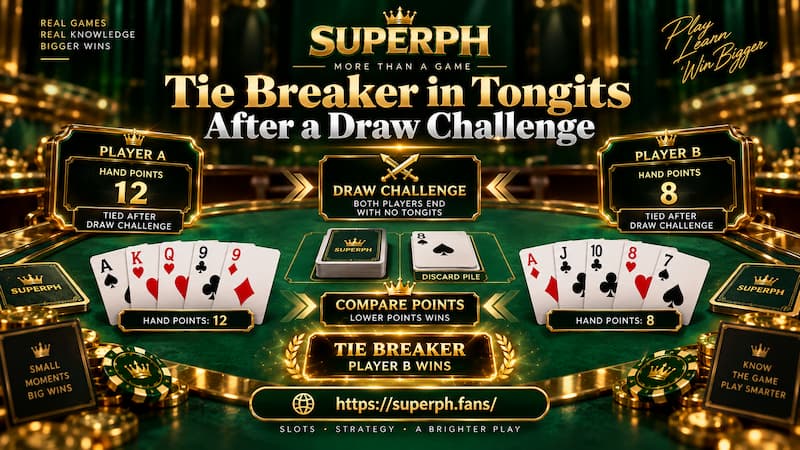
Tie Breaker in Tongits After a Draw Challenge
Calling Draw is not the same as reaching the end of the stock pile. The caller is actively saying that their remaining unmatched cards are low enough to win.
Eligible opponents can fold or challenge. If everyone folds, the caller takes the round. Once somebody challenges, however, the remaining card points are compared.
The basic sequence is straightforward:
- An eligible player calls Draw before taking the next card.
- Opponents decide whether to fold or challenge.
- Challenging hands are revealed.
- Unmatched card values are totaled.
- The lowest eligible total wins.
- If the lowest scores are equal, the tie rule is applied.
Under the traditional rule recorded by Pagat, a challenger wins a point tie against the player who called Draw.
Caller and Challenger Finish Equal
Imagine Ramon calls Draw holding only two unmatched cards:
- 5♣
- 2♥
His remaining total is 7.
Carlo challenges and reveals:
- 6♦
- A♠
Carlo also has 7 points.
Neither hand is lower, but they are not treated as equal winners. Under the traditional challenger-priority rule, Carlo wins because he challenged the Draw.
That makes a Draw call slightly more demanding than it first appears. Matching an opponent’s score may not be enough. The caller ideally wants to be clearly below any player capable of challenging.
Challenger Priority Settles the Tie
This detail changes how a close Draw should be judged.
Suppose you estimate that an opponent probably has somewhere between 6 and 10 points while you hold exactly 8. Calling Draw may feel comfortable, but an opponent challenging with the same 8 points can still beat you under this ruleset.
A one-point advantage therefore has genuine value. Seven against eight is clean. Eight against eight leaves the decision to the tie-break rule rather than the visible card total.
Two Challengers Have the Same Score
Three-way comparisons add another layer.
Suppose Player A calls Draw. Players B and C both challenge, and all three end with 9 points.
The caller loses tied comparisons against the challengers. B and C are still equal, so traditional Tongits uses seat position to separate them. Pagat specifies that the challenger to the right of the Draw caller wins the remaining tie.
Seat Order Becomes Part of the Result
At that point, no extra card is drawn and high-card rank does not suddenly become a separate contest. Position resolves the deadlock.
That is easy to miss when concentrating only on hand totals. In an especially tight round, knowing who called Draw and where each challenger sits can be just as important as seeing 9 versus 9 on the score display.
Tie Breaker When the Stock Runs Out
A completely different situation develops when nobody ends the round early and the face-down stock reaches its final card.
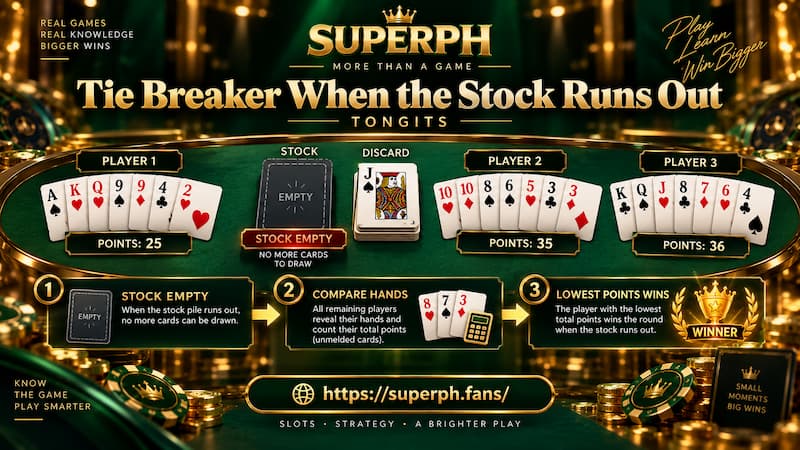
Tie Breaker When the Stock Runs Out
Eligible players then compare their remaining unmatched-card totals. Again, the lowest score wins, but equal scores do not use the same challenger rule because nobody initiated that particular comparison by calling Draw.
Traditional Tongits instead gives significance to the final stock card.
The Final Stock-Card Drawer Is Tied
Consider this finish:
- Ana draws the final stock card and ends with 8 points.
- Ben also has 8 points.
- Carlo has 14 points.
Ana and Ben share the lowest total.
Under the traditional stock-exhaustion rule, Ana wins because she drew the final stock card and is involved in the tie.
Example: 8 Points Against 8 Points
The important detail is not which player holds the highest individual card.
Ana could have 5 + 3 while Ben has 7 + Ace. Both totals are still 8. Once the scores match, the last-stock-card priority decides the result under this version of the rules.
It creates a satisfying final-turn tension: The last draw can matter even when the card itself does not improve the hand.
The Final Drawer Is Not Part of the Tie
Now change the numbers:
- Final-card drawer: 15 points
- Second player: 7 points
- Third player: 7 points
The person who took the last stock card cannot win on points, so the remaining two players must be separated another way.
Traditional rules award this tie to the player whose turn would have come next, described by Pagat as the player to the right of the person who took the final stock card.
Turn Position Decides the Remaining Tie
This is one of the details that disappears from many simplified Tongits explanations.
Tracking the stock pile is therefore more useful than simply noticing that only one card remains. Near stock exhaustion, remember who will take that last card and whose turn follows. A tied seven-point hand can suddenly be decided by that order.
Hand Points Come Before the Tie Break
A tie breaker in Tongits only becomes relevant after the remaining cards have been counted correctly.
Under widely documented traditional scoring:
- Ace = 1 point
- Cards 2 through 10 = face value
- Jack = 10 points
- Queen = 10 points
- King = 10 points
Only the relevant unmatched cards remaining in hand are counted for the comparison.
Different Cards Can Produce the Same Total
Two hands do not need to look alike to tie.
One player might hold:
- 6 + 4 = 10 points
Another might hold:
- 9 + Ace = 10 points
The second hand contains a 9 while the first tops out at 6, but both count as 10. Traditional scoring does not turn the higher individual card into an automatic secondary tie breaker.
This is why mentally totaling cards is more reliable than judging a hand by appearance.
Sunog Can Remove a Low Hand From Contention
A beautifully low total does not always guarantee eligibility.
In traditional Tongits, a player who has never opened a meld can be considered Sunog or burned when the round ends. An unopened hand also cannot challenge a called Draw under the commonly documented rules.
Imagine holding only 4 points while two opened opponents have 7 each. Those four points look excellent, but failing to meet the meld requirement can remove the apparent advantage entirely.
Three Common Tie Situations
The fastest way to remember the logic is to connect each tied score to the event that ended the round.
Draw Caller vs Challenger
Caller: 12 points
Challenger: 12 points
Traditional result: Challenger wins.
The tied score is resolved by challenge priority.
Final Stock Drawer in the Tie
Final drawer: 9 points
Opponent: 9 points
Traditional result: Final stock-card drawer wins.
The stock was exhausted, so last-card priority applies.
Other Two Players Tied
Final drawer: 15 points
Player B: 7 points
Player C: 7 points
Traditional result: Turn position separates B and C.
These examples show why asking only “Who has fewer points?” is incomplete. In a tied Tongits hand, you also need to know how the round ended.
Online Tongits Rules Can Differ
Traditional table rules are useful, but they are not a universal software specification.
Digital Tongits games can encode their own tie resolution. Casino Plus, for example, currently states that its stock-pile draw-fight ties are decided by position relative to the dealer, which differs from the last-stock-card method described in traditional rules.
That variation is important. A rule remembered from family games or another app should not automatically be carried into every online table.
Check the Active Tongits Rules on SUPERPH
When playing through SUPERPH, read the rules attached to the specific Tongits game before relying on a familiar tie-break convention. The provider’s programmed rules control the actual result, including how equal totals, Draw challenges, eligibility and position are handled.
If SUPERPH offers more than one Tongits version or game provider, the same habit becomes even more useful: Check the active rules once before playing rather than assuming every table follows the same traditional variation.
Decisions Near a Possible Tie
Close hands reward attention to details that seem minor earlier in the round.
Count the Unmatched Cards Exactly
Do not estimate by the number of cards left.
A hand containing King + Ace has only two unmatched cards but carries 11 points. Another player holding 3 + 2 + Ace has three cards yet only 6 points.
Card count and point count are not the same thing.
Keep Track of Your Open Meld
An exposed meld can determine whether you are eligible to challenge a Draw or remain competitive when the stock empties under traditional rules.
Waiting too long to open may preserve information, but it can also create Sunog risk. The decision has consequences beyond simply reducing the cards in hand.
Watch the Final Turns
As the stock becomes thin, remember three things:
- Who is likely to draw the last stock card
- Which players have already opened
- Whose turn follows the final drawer
If the totals finish level, one of those details may determine the winner before anyone needs to compare another card.
The Final Rule for a Tied Tongits Hand
Tie breaker in Tongits depends on the ending condition, not on a single universal “higher card wins” rule.
Under commonly documented traditional rules, a challenger beats a Draw caller when their point totals tie. If the stock runs out, the final stock-card drawer wins an equal lowest score when involved; otherwise, turn position can settle the tie.
Online versions may use a different programmed method, so check the active game rules first. Once that distinction is clear, an 8–8 finish stops looking confusing: The cards provide the score, but the way the round ended provides the tie breaker.