



How the Color Game Works with a Live Dealer
Live Dealer Color Game is available in SUPERPH’s live casino selection. The goal here is simple: Explain how a round moves from the betting window to the dealer’s three-dice reveal, how color matches are settled, and which table details should be checked before a bet is placed.
Live Dealer Color Game Table Setup
A Live Dealer Color Game round is built around three physical dice. Each die has six differently colored faces, commonly red, blue, green, yellow, white and pink. Instead of predicting a number, the bet is placed on the color expected to appear after the dice are rolled.
That changes the way the result should be read. A red bet does not require all three dice to land on red. Depending on the table rules, one red face may already produce a winning result, while two or three matching dice can produce a different payout.
The live table normally combines four elements:
- A human dealer controlling the round
- Three physical color dice
- An on-screen betting panel
- A countdown showing how long betting remains open
The dealer handles the physical action. The interface records wagers, closes betting at the cutoff and settles the result after the dice are revealed.
Three Dice, Six Colors
For one chosen color, each die creates another chance for that color to appear. Because all three dice are read together, several colors can win in the same round.
Imagine the final result is:
- Red
- Yellow
- Red
A bet on red has two matching dice. A yellow bet has one match. A blue bet has none. The result is therefore not a single “winning color” in the way a roulette wheel produces one winning number.
That distinction is small, but it is the key to understanding the entire game.
From Betting Window to Dealer Reveal
The actual round moves quickly. Once the sequence becomes familiar, there is very little guesswork about what happens next.

From Betting Window to Dealer Reveal
Placing a Color Bet
During the open betting period, choose a color and select the amount to wager. When playing with a PHP-denominated balance, the stake is shown in Peso.
A simple example would be a PHP 100 wager on green. The bet must be accepted before the countdown reaches zero. Merely highlighting a chip or tapping a color at the final second does not guarantee that the wager has entered the round.
Before confirming it, check three things:
- The amount placed on the color
- The table’s minimum and maximum limits
- The displayed payout rules
That last check matters because “Color Game” is a game format, not one universal paytable shared by every live casino provider.
Betting Closes
When the timer expires, the table enters its locked stage. No additional bets should be added or removed once the round has closed.
This creates a different rhythm from instant digital games. There is a short period for choosing the bet, then a definite cutoff followed by the physical result.
The Three-Dice Reveal
The dealer rolls or releases all three dice together. Once they stop, the upper-facing color on each die forms the official result.
Suppose the dice show:
Blue — Blue — Pink
Blue appears twice, pink appears once and the remaining colors do not appear.
The important habit is to read all three dice before judging the outcome. Looking only at the first visible color can be misleading because a second or third match changes the result on tables where payouts increase with the number of matches.
Automatic Settlement
After the final colors are confirmed, the system settles qualifying bets according to the table’s rules. Winning amounts are credited automatically, losing positions are cleared and the next betting window opens.
The live dealer does not manually calculate each player’s PHP return. That process is handled by the game system, which is why the published paytable deserves more attention than assumptions carried over from another Color Game room.
Color Matches and Payout Logic
Traditional Live Dealer Color Game rules are easy to understand once the number of matching dice becomes the focus.
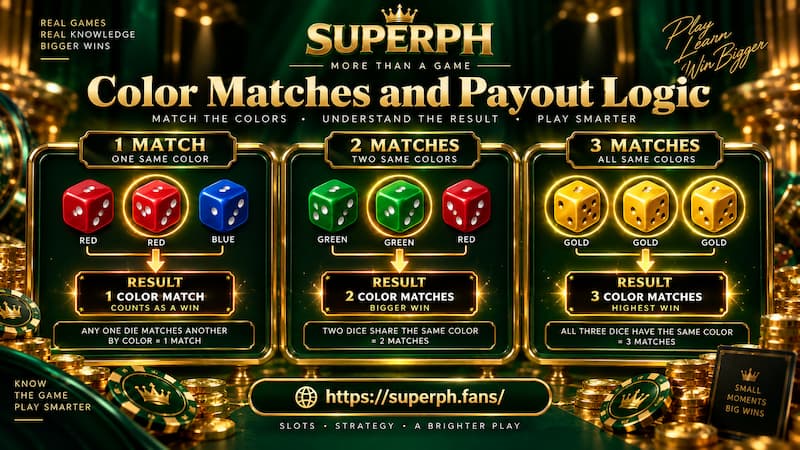
Color Matches and Payout Logic
A common classic structure works like this:
- One matching die: 1:1
- Two matching dice: 2:1
- Three matching dice: 3:1
Those figures should not be treated as universal. Some newer versions use a special feature, multiplier or bonus round when all three dice show the same color.
For that reason, the live paytable inside SUPERPH should be checked before the first wager rather than relying on a payout chart remembered from somewhere else.
One Color Versus Multiple Colors
Some tables allow bets on several colors during the same round. Doing so covers more possible outcomes, but it also increases the total amount exposed.
For example, placing PHP 100 on red and PHP 100 on blue means PHP 200 is committed to the round. If only red appears once, the red position may win under the table rules while the blue position loses.
The wider coverage does not change the probability of any individual die.
That is an important distinction. More colors can mean more ways to register a match, but they also mean more separate wagers are being funded.
Triple-Color Results
Three identical colors are much rarer than a single match, so this is also where provider-specific rules tend to become more noticeable.
A traditional room may simply apply its listed three-match payout. Another version may trigger an additional live feature instead. Modern Color Game releases increasingly use bonus wheels, multipliers or special rounds around triple matches.
Never assume that “three reds” produces the same return everywhere. The correct answer is always the one written in the active table rules. Provider-specific rules are also why Evolution Casino titles such as Super Color Game should be read from their own paytables rather than treated as identical to every other Color Game.
Probability Behind the Three Dice
The six-color structure produces a useful mathematical picture.
Assuming each die has six equally likely colors and the dice operate independently, a particular chosen color has the following probabilities across three dice:
- No appearance: 125/216, or about 57.87%
- Exactly one appearance: 75/216, or about 34.72%
- Exactly two appearances: 15/216, or about 6.94%
- Three appearances: 1/216, or about 0.46%
The most common successful result for one selected color is therefore a single match. Two matches occur far less often, while three matching dice are uncommon.
Result History Does Not Change the Next Roll
A live results board can be interesting to watch, especially after an unusual sequence. Five rounds containing red can easily create the feeling that red has become “hot” or that another color must now be due.
Neither conclusion follows from the previous rolls.
If each roll is independent, the next set of dice does not remember what happened ten seconds earlier.
A streak describes completed rounds. It does not rewrite the probability of the next independent roll.
Result history is useful as a record. It should not be confused with a forecasting tool.
Live Dealer and Digital Color Game
The basic color-prediction idea can appear in both live and fully digital formats, but the experience is structurally different.
Live Dealer Format
Live Dealer Color Game normally includes:
- A real-time dealer
- Physical dice or live game equipment
- A visible betting countdown
- A studio video feed
- A physical dice reveal
- A fixed round pace
The result comes from the live table action rather than an instant software animation. That gives each round a clear beginning, betting cutoff and reveal.
Digital or RNG Format
A digital Color Game can remove the dealer entirely. RNG can generate the result electronically, rounds can move faster and the interface may include different betting options.
The name alone does not guarantee identical rules.
A digital game and a live game can both be called Color Game while using different paytables, limits, bonus mechanics and round speeds. Treat the exact game room as the source of truth.
Reading the SUPERPH Table Before Betting
The useful information is usually visible before any money needs to be committed.
Start with the provider name and exact game title. “Color Game,” “Super Color Game” and a bonus-oriented Color Game can share the same basic three-dice idea while handling special outcomes differently.
Then check the PHP limits. A comfortable stake on one room may be below the minimum or above the maximum on another.
Four Details to Check
Bet Limits
Confirm the smallest and largest accepted wager. This prevents last-second adjustments when the countdown is already running.
Match Payouts
Check how one, two and three matching dice are paid. Do not assume 1:1, 2:1 and 3:1 unless those figures are actually displayed.
Bonus Conditions
Look for special rules attached to three matching colors, side bets, multipliers or bonus rounds.
Betting Cutoff
Know when the table stops accepting wagers. A well-planned bet placed after the cutoff is still a missed round.
Common Live Color Game Mistakes
Most confusion at a Live Dealer Color Game table comes from reading the mechanics incorrectly rather than from the dice themselves.
Confusing Profit with Total Return
Suppose PHP 100 is placed on a color and a 1:1 wager wins. A PHP 100 profit plus the original PHP 100 stake produces PHP 200 returned in total.
Calling that simply a “PHP 200 win” can blur the difference between profit and returned stake.
Treating Streaks as Predictions
Three consecutive rounds containing yellow do not force yellow to disappear next. They also do not make a fourth yellow appearance inevitable.
Past dice stay in the past.
Assuming Every Table Uses Identical Rules
This is the mistake most worth avoiding. The three dice and color matching may look familiar, yet payout structures and special features can change between providers.
SUPERPH can carry the Live Dealer Color Game format within a broader live casino selection, but the active game’s own paytable still determines how that particular round is settled.
Understanding the Round Before the First Bet
Live Dealer Color Game becomes straightforward once the sequence is clear: Choose a color, place the wager before betting closes, watch the dealer roll three dice, count how many times the selected color appears and let the table settle the result under its published rules.
The deeper point is not complicated either. Learn the base three-dice mechanic first, then read the exact table rules before attaching a payout figure to any result. That keeps a familiar Color Game from becoming confusing simply because a different provider handles doubles, triples or bonus features in another way.